Someday Script: Modern Elegance with Authentic Flourishes
In the landscape of contemporary typography, script fonts offer a distinct avenue for expressing personality and mood. Someday Script emerges within this category as a design that balances modern readability with romantic, playful embellishments. Its defining characteristic is an array of incredibly authentic swashes—those flowing extensions and decorative strokes that give script letterforms their flourish. This article provides an objective evaluation of Someday Script, exploring its attributes, potential applications, and considerations to help designers and creatives determine its suitability for their projects.
Understanding the Characteristics of Someday Script
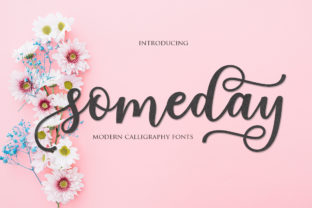
Someday Script is a digital typeface belonging to the script or handwritten font style. It is crafted to emulate the aesthetic of casual yet elegant calligraphy, but with a structure that ensures legibility in various contexts. The "modern elegance" cited in its description suggests a design that avoids overly historic or formal script traits, leaning instead towards a cleaner, contemporary baseline letter shape. The key feature, however, lies in its optional swashes. These are not merely uniform decorative add-ons; they are described as "authentic," implying a varied and organic integration with the core characters, offering a natural, hand-drawn feel.
Core Design Elements
The font typically includes multiple OpenType features. Alongside the standard character set, you will likely find:
- Alternate glyphs for certain letters.
- A comprehensive set of swashes for both initial and terminal letter positions.
- Possibly ligatures that connect letters fluidly.
This toolkit allows for significant customization within a single typeface family. Users can apply swashes selectively to create a more ornate composition or stick to the basic forms for a simpler, modern script look. This versatility is a central part of its value.
Potential Benefits and Reasons for Interest
Interest in Someday Script often stems from specific design needs. It is not a utilitarian font for dense body text but a stylistic choice for projects requiring a touch of personality.
Visual Appeal and Emotional Tone
The primary benefit of Someday Script is its capacity to establish a specific tone. The playful and romantic nature, enhanced by authentic swashes, can convey feelings of warmth, creativity, affection, or lighthearted elegance. It is suitable for projects aiming to feel personal, crafted, or celebratory without venturing into overly formal or antiquated territory.
Versatility Through OpenType Features
The inclusion of authentic swashes and alternates within a modern framework offers practical design flexibility. A user can set a headline in the basic script for clean impact and then apply a single terminal swash on a key word for emphasis. This controlled approach to decoration prevents the design from becoming uniformly ornate, which can sometimes hinder readability or feel dated.
Modern Legibility Foundation
Compared to some script fonts that prioritize flourish over function, Someday Script's underlying modern elegance suggests letterforms that are reasonably clear and spaced. This makes it potentially more viable for shorter blocks of text, like invitations, product descriptions, or logos, where readability remains important alongside style.
Tradeoffs, Considerations, and Practical Expectations
Selecting any stylistic font involves balancing its aesthetic strengths with functional limitations. Someday Script presents several important considerations.
Usage Context Limitations
Script fonts, including Someday Script, are generally ill-suited for long-form body text. Their varying letter connections and decorative potential can disrupt reading flow over extended paragraphs. Expect to use Someday Script primarily for display purposes: headlines, logos, short quotes, packaging, wedding materials, branding elements, and social media graphics. Its effectiveness is highest in contexts where visual impact is paramount.
Technical Application Knowledge
To fully utilize the authentic swashes and alternates, users need access to software that supports OpenType features—such as Adobe Creative Suite, Affinity applications, or advanced web font settings. They also require a basic understanding of how to access and apply these features. Without this, one might only use the standard character set, missing a significant aspect of the font's design value.
Potential for Overuse
The very attractiveness of the swashes can lead to overapplication, where every letter in a word is adorned, resulting in a cluttered or overly busy appearance. Effective use requires restraint and typographic judgment. The "authentic" quality suggests they are designed to work harmoniously, but thoughtful selection is still key.
Situations Where Someday Script is a Strong Fit
Certain project types align particularly well with the attributes of Someday Script.
- Wedding and Event Branding: The romantic and playful nature, with customizable elegance, fits invitations, signage, and websites for weddings, anniversaries, or celebratory events.
- Personal Branding for Creatives: Artists, bakers, florists, lifestyle bloggers, or boutique owners might find it resonates with a hand-crafted, personal brand identity, especially for logos and promotional headers.
- Product Packaging for Lifestyle Goods: Products in the beauty, confectionery, gift, or artisan sectors could use Someday Script on packaging to imply care, quality, and a touch of whimsy.
- Limited Text Digital Graphics: For social media posts, quote graphics, or website banners where text is brief and visual appeal is critical, the font can provide standout elegance.
In these scenarios, the font’s ability to toggle between modern simplicity and authentic flourish allows it to adapt to different pieces within a cohesive project.
When to Consider Alternatives
Someday Script may not be the optimal choice in every circumstance that calls for a script font or personal touch.
- Projects Requiring Extreme Formal Tradition: For designs needing a very formal, copperplate-style script with strict regularity, a more classic calligraphic font would be appropriate.
- Projects Demanding Utilitarian Readability: Any context involving lengthy readable text, such as a book, lengthy website article, or instructional material, necessitates a simpler sans-serif or serif font.
- Brands Targeting Minimalist or Brutalist Aesthetics: If the brand identity is built on stark simplicity, raw geometry, or industrial tones, a script font like Someday Script would likely conflict with that core message.
- Technical or Budget Constraints: If the final output environment cannot support OpenType features (like some basic web builders), or if the project budget cannot accommodate a premium script font, free or more basic script alternatives might be necessary.
Exploring other script fonts with different balances—some more casual, some more structured, some with fewer swashes—is advisable to ensure the chosen typeface perfectly matches the project's tone and technical requirements.
Practical Decision-Making Insights
Evaluating whether Someday Script aligns with your goals involves a concrete assessment.
Define the Project's Primary Tone
Clearly articulate the emotional or brand message needed. Is "playful and romantic elegance" a core component? If the tone leans more toward serious authority, tech innovation, or stark minimalism, another font category is likely better.
Audit the Technical Context
Confirm that your design software and final output platforms (web, print, mobile) can handle OpenType features if you intend to use the swashes. This is a crucial functional step.
Test Extensively Before Commitment
If possible, obtain a trial version or test the font in a mock-up of your key applications. Set headlines, see how swashes interact with your specific words, and assess readability at intended sizes. This practical test will reveal more than a simple preview.
Consider the Entire Typographic System
Someday Script will rarely be used alone. Evaluate what complementary fonts—a neutral sans-serif for body text, perhaps a simple serif for subtitles—you will pair with it. The success of a display script often depends on this supportive pairing.
Ultimately, Someday Script offers a specific blend: a modern script foundation enriched by authentic, playful flourishes. Its value is maximized in projects where that blend directly supports the communicative goal and where the designer has the means and intention to leverage its stylistic features thoughtfully. By weighing its aesthetic benefits against its practical considerations and clearly assessing your project parameters, you can make an informed decision on whether its modern elegance is the right fit for your creative needs.