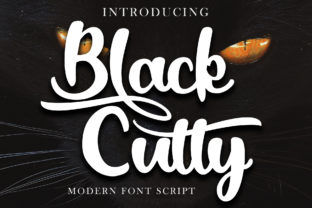
Black Catty Script: A Handcrafted Typeface for Authentic Design
In a digital landscape saturated with polished, corporate fonts, finding a typeface with genuine character can be a challenge. Enter Black Catty Script, a playful and expressive script font designed to inject personality and a handcrafted feel into your projects. Unlike the rigid uniformity of many standard fonts, Black Catty Script offers an authentic, almost whimsical vibe. It doesn’t shout; it charms. For professionals, creators, and anyone looking to add a personal touch, this typeface is a tool for moving beyond generic aesthetics and connecting more directly with an audience.
Understanding Black Catty Script’s Role in Your Creative Process
Black Catty Script is more than just a font file; it’s a stylistic asset with a specific function. It fits into the broader process of visual communication and branding as a solution for moments that require warmth, approachability, or a distinct human touch. Its irregular baseline, varied letterforms, and organic flow mimic the imperfections of real handwriting, which carries an inherent sense of authenticity. This makes it unsuitable for long blocks of body text or formal legal documents, but perfect for accents, highlights, and statements where emotion is key.
Integrating Black Catty Script effectively requires considering its role before, during, and after a design project. In the initial planning stages, you might identify key visual elements—like a logo tagline, a special offer banner, or a personalized headline—where a script font would enhance the message. During the execution phase, you apply it carefully to these predetermined spots, ensuring it complements rather than clashes with your other typography. Finally, in the review or quality control phase, you assess its impact on the overall design’s tone and readability.
Practical Integration with Other Design Assets
Black Catty Script never works alone. Its success depends on thoughtful interaction with other tools and elements in your workflow. It typically serves as a secondary or accent font, paired with a more legible primary sans-serif or serif font for body content. This pairing creates a balanced hierarchy: the sturdy primary font handles information delivery, while Black Catty Script provides stylistic emphasis.
Consider its use in a social media campaign graphics. You might use a clean, geometric font for the main statistic or fact, and then employ Black Catty Script for a short, impactful call to action like “Join the Fun!” or “Get Your Copy.” This combination leverages the script’s personality to make the actionable part of the graphic feel more inviting. Similarly, in a small business’s printed flyer, product descriptions in a neutral font gain a friendly lift from a Black Catty Script headline announcing a “Summer Sale.”
The font also interacts with other visual assets like color palettes and imagery. Its organic style pairs well with natural textures, warm colors, and illustrations rather than stark, minimalist photography. Ensuring this compatibility during your asset selection phase prevents stylistic dissonance.
Implementing Black Catty Script: Workflow Tips and Observations
To weave Black Catty Script smoothly into your routine, a few practical considerations will boost efficiency and consistency. First, preparation is crucial. Once you’ve licensed and installed the font, create a simple style guide snippet for yourself or your team. Note its intended use cases (headlines, accents, short quotes), recommended pairings, and sizes where it remains legible. This prevents ad-hoc misuse and maintains brand coherence across multiple projects.
Usability hinges on moderation. Because of its detailed strokes and script nature, Black Catty Script can become difficult to read at very small sizes or when used for lengthy sentences. A good rule is to reserve it for display purposes where size can be generous. Also, pay attention to spacing. Its natural flow sometimes requires manual adjustment of letter spacing (tracking) in your design software to ensure characters connect visually without crowding.
For long-term use, particularly in branding, consistency is key. If you decide Black Catty Script represents your brand’s “personal voice,” use it systematically for specific elements across all mediums. For example, a blogger might use it exclusively for the titles of their “Personal Thoughts” essay series, creating a recognizable visual cue for readers. This repeated, strategic application builds stronger association than random, occasional use.
Specific Workflow Examples Across Professions
The application of Black Catty Script varies by role and project type. Here are a few targeted examples of how it fits into different workflows:
- For Freelancers & Small Business Owners: When designing a client’s wedding invitation suite, you could use a formal serif for the information details, and Black Catty Script for the couple’s names at the top. This immediately personalizes the document. In your own business materials, using it on your website’s “Welcome” message or the signature line in your email newsletter adds a distinct, memorable touch that sets you apart.
- For Marketers & Content Creators: In a video ad campaign, Black Catty Script can be animated for key on-screen text overlays, making statistics or quotes feel more dynamic and engaging. For a product launch landing page, using it for the subheading under the main robotic logo (“Crafted with Care”) can soften a technical brand with human warmth.
- For Educators & Hobbyists: Creating a personal planner or a workshop handout? Use Black Catty Script for section titles like “My Goals” or “Today’s Inspiration.” This transforms a utilitarian document into something more motivating and pleasurable to use. In a craft blog, it’s perfect for highlighting key tips or the names of handmade projects within your post images.
Factors for Successful Long-Term Use
Beyond the immediate design, thinking about organization, efficiency, and quality control will help you leverage Black Catty Script as a lasting asset. Keep your font files organized in a dedicated “Brand Assets” folder alongside your logo and color specs. This makes it instantly accessible for any new project and prevents you from defaulting to a standard system font out of haste.
Efficiency comes from mastering its nuances. Spend a little time experimenting with the font in your preferred software (Adobe Creative Suite, Canva, etc.) to understand how it behaves. Note how it looks in different weights if available, and test it against various backgrounds. Creating a few reusable template components—like a social media post frame with a placeholder Black Catty Script headline—can speed up future production.
Quality control involves a final check for legibility and harmony. Before finalizing any design, view it at actual size and ask: Is the script text clear? Does it fight with other elements? Does it enhance the intended emotion? Getting a second opinion from a colleague or target audience sample can be invaluable here, as script fonts are subjective. Their authentic vibe is powerful, but only when applied with discernment.
Ultimately, Black Catty Script is a bridge between digital precision and human expression. It offers a way to signal individuality, warmth, and creativity within structured design processes. By understanding its place as an accent tool, preparing for its use, pairing it wisely, and applying it consistently to specific elements, you can integrate its fun and cool character into your work seamlessly. The outcome is design that feels less manufactured and more genuinely connected—a subtle but significant advantage in any visual communication task.